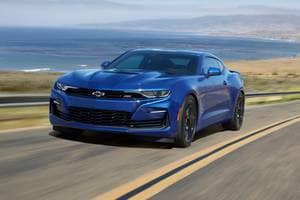
I'm tired of unintended acceleration. I want to get back to talking about acceleration that is fully intended (and appreciated) and the cars that are built to manage it well. What better way to take the automotive equivalent of a Silkwood Shower than a suspension walkaround of our 2010 Chevrolet Camaro SS?
Let's get right to it, shall we?
Up front, there's a coil-over MacPherson strut.
But the lower end does not have the single L-shaped lower arm that most strut suspensions have. Instead, there are two lower links (white), each with its own ball joint, just like the closely-related Pontiac G8 GT.
The front stabilizer bar (green) connects to the strut body via a long, slender link (yellow) for a 1:1 motion ratio.
Like most cars with north-south engines and rear-wheel drive, the Camaro's steering arm (yellow) acts ahead of the axle centerline. The hub carrier it attaches to (white) is aluminum, unlike the Pontiac G8, which uses one made of steel.
Here's a closer look at the dual lower links and their ball joints. The forward one (yellow) comes in from above so that the steering arm can sneak past underneath.
Them's some big brakes - much bigger than the 2-piston sliding calipers found on the front of our dearly departed G8 GT. These calipers (green) are 4-piston fixed units from Brembo. A clump of mass-damping weights (white) have been unceremoniously stuck to them (where they don't show much), presumably to quell a resonant vibration. The ventilated rotors (yellow) are 1-piece cast units.
Out back, the rear multi-link suspension looks very, very similar to that found in the G8 GT. Like the Pontiac, "multi" in this case means three links and one L-shaped upper arm.
Two links (green forward, red aft, behind the shock) make up what amounts to a lower wishbone. The fully boxed upper arm (white) curves off behind the shock to meet its hidden second pivot. A toe-link (yellow) keeps the wheel pointed in the right direction.
Here's a snail's-eye view of the lower links and their wishbonesque arrangement.
Left to right (and bottom to top): forward lower link (yellow); toe link (green); and upper arm (white). The forward upper pivot of the upper arm, a pillow ball, is just barely visible. The rear pivot is a higher volume rubber bushing that's hidden off behind the spring and shock.
The rear lower link does quite a bit of work as the spring/shock assembly and the stabilizer bar connect to it. The shape is slightly different from that of the G8 GT, but it's very close. The stab bar motion ratio looks about the same(0.4:1), but the spring/shock motion ratio looks a little smaller (0.7:1).
Like the front, the Camaro's rear knuckles (yellow) are made of aluminum. Those of the Pontiac G8 GT are steel. They also house ginormous 4-piston fixed Brembo calipers of an open design for easy pad swaps and an external crossover tube (black) to send fluid to the outer pair of pistons.
That'll do.
Front tires: 245/45ZR20 (103Y), weighing in at 63.0 pounds
Rear tires: 275/40ZR20 (106Y), weighing in at 67.5 pounds.
If you care to compare to the Pontiac G8 GT walkaround, go here. You'll see the major differences, but many important departures from the G8 are invisible to the naked eye: the spring rates, the internal valving of the struts and shocks, bushing hardness and a host of others. Such suspension tuning differences are not to be underestimated.
Dan Edmunds, Director of Vehicle Testing @ 16,487 miles (or is it 14,867?)

stovt001 says:
03:56 PM, 03/23/10
Amen! I can sure be OK with getting off of the whole unintended acceleration thing.
Its about time you got around to the Camaro SS. After all, its IRS (and the Mustang's lack thereof) was a big marketing point.
bankerdanny says:
03:57 PM, 03/23/10
Facinating as usual. I wonder if the aluminum pieces from the Camaro will bolt to the G8, and if the (presumed) improvement in unsprung weight would make the already good ride of the Pontiac even better.
oachalon says:
04:04 PM, 03/23/10
you guys need to wash your calipers. They are filthy, well you guys drive it like a daily driver so its expected. The calipers on my daily driver are filthy also.
rick8365 says:
04:17 PM, 03/23/10
Great to see another walkaround - thanks.
Man-o-man that steering arm comes so close to that link!
subytrojan says:
04:37 PM, 03/23/10
That's some crazy unsprung mass!
Dubs FTL!
stovt001 says:
05:35 PM, 03/23/10
Agreed with Subytrojan. On the Camaro5 forums I'm part of a group disappointed with the weight of the Camaro, but the good news is wit so much unsprung weight, a simple swap to lighter wheels and some other minor modifications can go far curing the weight problem.
surfwagon56 says:
06:26 PM, 03/23/10
Do all cars have sticky weights on their brake rotors? Never seen this before.
surfwagon56 says:
06:44 PM, 03/23/10
Meant calipers, sorry
roadburner says:
06:59 PM, 03/23/10
"a simple swap to lighter wheels and some other minor modifications can go far curing the weight problem."
Lighter wheels can make a HUGE difference.
stovt001 says:
08:02 PM, 03/23/10
@surfwagon: Apparently Brembo screwed up the balancing on early batches of calipers, and the wheel weights were a (pretty shoddy) quick fix by GM to avoid further production delays. Later Camaro builds had properly balanced calipers without the weights. I'm not sure if GM is offering the permanent solution to those with the wheel weight fix. A quick search of the Camaro5 forums should turn up the answer.
joefrompa says:
04:43 AM, 03/24/10
Those tires are likely 24-28 pounds a piece, meaning those wheels are scratching on 35-40 pounds per wheel.
That's unholy. At the same time, it should be fairly easy to get good, strong, inexpensive wheels for $200-300 a pop (or so) that will shave 10-15 pounds of weight per corner of rotating unsprung mass.
That is so much weight loss that I can't even imagine the gain in agility.
Awesome suspension walkaround and nice setup for the car. That steering arm IS crazy close!
bodyblue says:
05:44 AM, 03/24/10
Maybe the weight of the wheels has something to do with most magazines review of the track performance of the SS. "Piggish" was one of the best descriptions. The caliper weights are an example of GM at its best......letting the public perform final testing of the product.
rick8365 says:
06:50 AM, 03/24/10
Why would the/do the calipers need to be "balanced"?
Dan said - "A clump of mass-damping weights (white) have been unceremoniously stuck to them (where they don't show much), presumably to quell a resonant vibration."
"Balancing" would be something different, no? That said, I really don't get how this works or why the weights would be needed on calipers....kind of get it when they are attached to the frame; but calipers?
actualsize says:
06:52 AM, 03/24/10
@everybody: the steering arm may be close, but remember that this Camaro is sitting at full droop and full left lock. The clearance will increase in any other position.
@bakerdanny: The pieces don't look interchangeable. The pockets at the end of the links and arms, where the connection to the hub is made, are shaped differently. It might be necessary to look at swapping all of it as a matched set. Probably cheaper to look at lighter forger wheels in 19" size (if they'll fit over the brakes). I am so over dubs for the sake of dubs. IMHO, anything over 18" seems to represent the point of diminishing returns.
Dan
roadburner says:
07:12 AM, 03/24/10
"That's unholy. At the same time, it should be fairly easy to get good, strong, inexpensive wheels for $200-300 a pop (or so) that will shave 10-15 pounds of weight per corner of rotating unsprung mass."
Agreed. The OEM 18" wheels on my MS3 weigh @24 pounds each. The 18" Enkei Racing RPF1 weighs just 17.6 pounds, while the 18" O.Z. Ultraleggera tips the scales at 18.4 pounds. Eliminating @6 pounds of unsprung mass at each corner should make a significant impact on overall handling. As for the Camaro, the 20" Ultraleggera weighs 24 pounds and the tires will weigh around 31 pounds, so call it 55 pounds total- 8 pounds per corner.
actualsize says:
07:17 AM, 03/24/10
@everybody: The steering arm may be close, but remember we're looking at a suspension at full droop and full left lock. The clearance will increase in any other position.
@rick8365 & stovt001: The calipers aren't a rotating mass, so these are not balance weights. Mass damping weights, such as these, aim to alter the mass of the part (in this case the caliper) to change its natural resonant frequency. Without the weights, this caliper's resonant frequency probably matches some other vibration in the suspension, causing the caliper to vibrate in sympathy. Since we're talking about a caliper, said vibration might either be heard or felt as a vibration in the steering wheel. Change the weight of the caliper and you change is natural frequency and eliminate the sympathetic relationship to whatever other part it was harmonizing with.
rick8365 says:
07:50 AM, 03/24/10
Thanks for the explanation, Dan.
I fully understand that the calipers do not rotate, hence my question. What I don't fully understand in the whole resonant frequency thing but that's alright, "I get it" enough from your explanation.
Also, noticed/thought about the full lock on the steering arm clearance but NOT the full droop - good point.
evil1487twin says:
07:51 AM, 03/24/10
Get a grip, real people don't want to use all of those ugly pieces and thingamajigs. Nobody makes a buying decision because of those knuckles and arms and links. You certainly wouldn't show these pictures of the ugly side of an overpriced BMW, now would you?
actualsize says:
08:14 AM, 03/24/10
Apart from the extra metal present in the big wheels, here are other reasons why these wheel and tire assemblies weigh so much.
They're big. The overall outside diameter is 28.7 inches. The look cool and fill up the fenders, but it used to be the car tire diameters stopped at 25 or 26 inches. Modern cars are styled around huge Hot-Wheel wheels and tires. We pay a performance price for that. Those aluminum knuckles on the Camaro may actually be a necessity to offset all of that wheel and tire weight. I haven't done the math, but the Pontiac G8 GT with it's steel knuckles might actually have less unsprung mass per corner than our Camaro.
The volume of air in the tire is what holds a car up and shoulders the load. Use a low profile tire and a larger diameter wheel and you reduce the volume of air inside and the load capacity. To make it back, you have to use reinforced "extra load" or XL tires. XL tires used to be called "limo tires" because, in the past, only limousines needed reinforced tires. But the increased use of dubs and low profile tires (and the increased weight of cars in general) has meant an increase in the use of reinforced XL tire sizes like those found on the Camaro.
cruiserhead1 says:
08:28 AM, 03/24/10
Love these suspension walkarounds, Dan. It helps judge the quality of engineering and design.
I wish they were the norm in evaluating new cars.
It also helps determine how easy the car will be to work on.
One thing I look at when buying a car is the access to frequent maint items in the engine bay and also the quality of the components.
The long term durability and prevention of leaks, replacements, etc can be judged there.
stovt001 says:
09:19 AM, 03/24/10
@actualsize: Correct about the weights not "balancing" the calipers. I knew the real explanation is exactly what you said, but essentially I was too lazy to type that, so I called it balancing which as you noted is incorrect. Chalk it up to laziness.
jederino says:
02:13 PM, 03/24/10
What jack point did you use to raise this single corner? I just can't make it out in the pics. I have only used the center front jack point to raise both fronts when I'm swapping winter/summer tires.
jazzor says:
07:02 AM, 03/26/10
63+ lbs on wheels alone... holy crap. I understand the rear for having wide rubber, but 245's is what my AMS-ecu-tuned '09 Ralliart uses and with OZ Rally Aleggeritas comes to a total of 40lbs :-/
with stock wheels and 215mm tires it was about 47lbs, the savings came to about 7lbs per wheel plus an increase in size of 1" (18x8 instead of 18x7 stock) and an increase in contact patch of 30mm which improves overall acceleration and decreases total sprung weight, which also helps with stopping distance. Does Chevy engineers know any of these? the total acceleration in a 1/4 mile improved from a 13.4s which was my fastest, to a 13.2s, as well as 1/8mile decrease of 8.94s to 8.46s, and best 60' of 1.9200 which can still be improved but would give previously give me a 2.2200
What a cow!
number3 says:
05:00 AM, 09/14/10
So basically you believe that because you can buy an aftermarket wheel that weighs less that somehow GM engineers are incapapble of understanding the basic fundamentals and impact of unsprung mass?
You are comparing only one single element of the wheel..........mass.
Do all aftermarket wheels pass the structural tests GM requires? Do you know?
Did you further know that wheel structure impacts NVH performance?
I can assure you there is a lot of effort put into wheel design. GM has a world class wheel and tire lab that does nothing but focus on........tadaaahhhhhh....wheels and tires.
So yes, you have aftermarket opportunities you can choose, but don't assume they are all good choices.
And as for the brake weights, the later 2010 and 2011 Camaros have the weights built in to the caliper design. This is an older car used for the review.
stress83 says:
07:46 AM, 09/14/10
Another point that was lightly touched on with the wheels & tires: The 5th gen Camaro was essentially a show car made public. Hence, we get the cartoonish demeanor with oversized wheels and tires. I'm confident that a smaller 6th gen Camaro will be more true to what is "normal" with this class of car.
orbit09 says:
08:44 AM, 09/14/10
For all of you that would suggest swapping for lighter wheels and tires; you may want to keep in mind that heavy tires help torque-y cars get traction and if you go with a drastically ligher wheel you're going to want to be very careful on slick roads.
alukashe says:
12:54 PM, 09/14/10
That's an epic post you have there sir. (orbit09)
6sptl says:
09:02 AM, 09/15/10
Nice to see GM adopting a suspension that every Honda has had for almost 40 years now. WOW, now that is progress! The v6 has variable timing too! Something every honda has had for the last 20 years! Were cooking with gas now. This thing is still an engineering midget compared to a 20 year old prelude.
alukashe says:
10:33 AM, 09/15/10
They just keep coming.
actualsize says:
09:24 AM, 09/22/10
@ 6sptl: Don't Honda Civics use struts now? The Insight has a twist-beam rear axle. And, last I checked, Honda doesn't make anything that's RWD apart for the S2000. (NSX=dead). My Odyssey's transmission will be lucky to make it to 80k miles--the one coupled to the V6 is a known turd. And don't get me started on their brakes.
Point is, it's not as simple as you make it out to be. All car companies make different choices at different points in time. Car brands that were once strong can falter, and vice versa. Nobody's status, good or bad, is permanent. Try to keep an open mind. Perspective is a good thing.
6sptl says:
12:04 PM, 09/24/10
Actual, The camaro is still a turd. Seas of cheap plastic with terrible ergonomics , a limp suspension and a v6 that is finally "modern" . Not good news for a company that is just recovering from falling off a cliff. "muscle cars were crap in the 70's, they are still crap. Muscle cars were fast only in peoples imaginations. Most of them were slower than todays v6 family sedans, thus this revival of cars that were slow, drove horribly and were lemons is for the birds.
spencewilliams says:
11:13 PM, 09/25/10
I just wanted to say that I really appreciate and enjoy these Suspension Walkaround posts. I have brought them to the attention to one of my teachers at the automotive technician program I attend, as they are an excellent resource for comparing different suspension setups in new cars. These posts are the reason I just signed up to comment on InsideLine.
I'm also really pleased with the quality of comments and the maturity of commenters on this site. A very nice change in comparison to the culture at a lot of automotive sites.
Please, keep these posts coming!
6sptl says:
01:47 PM, 12/27/10
Couldn't this thing be any cheaper? Not much better geometry than a chevy citation. At least the brakes are decent if crapped on engineered with stickon balancing. Sheesh.