Long-Term Road Tests

Daily updates on our fleet of cars and trucks

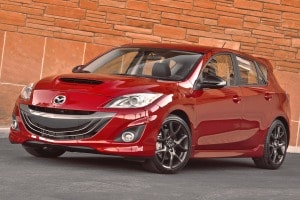
2010 Mazdaspeed3: Suspension Walkaround

2010_Mazdaspeed3_1600_suswalk_fr_det_brk_2.jpg

With a new floor jack in hand, it's finally time to get back into suspension walkaround mode. And it just so happens that I brought said jack home in the back of our 2010 Mazdaspeed3.

Let's see what she looks like with the wheels off.


2010_Mazdaspeed3_1600_suswalk_fr_oa_low_fr.jpg

The Mazdaspeed's front suspension is standard fare you'll find on most front-drive compacts: A MacPherson strut (green) paired with an L-shaped lower control arm (yellow). A lot of these parts look very similar to those found within our departed 2008 Ford Focus SES.

But these components are even more similar to those found on the European Ford Focus - the one we don't get here. That's because the Euro Focus and the Mazda 3 both use Ford's C1 platform, wheras the US Focus uses the closely-related C170. Ford and Mazda may have parted ways, but this project was well along before that came to pass.

In fact it may help to switch back and forth to the 2008 Ford Focus suspension walkaround every now and then as we move along.

Struts almost always have their coil-over springs mounted at what looks like an odd angle relative to the strut body itself. Here you'll notice that the spring axis lines up with the steering axis. This spring orientation seeks to offset the side loads (and therefore the friction) that build up due to the off-axis orientation of the strut.


2010_Mazdaspeed3_1600_suswalk_fr_LCA_above.jpg

Here's a view of the L-shaped lower control arm from above. The orange arrow shows where the subframe terminates at the forward LCA mount, just like our Focus. Meanwhile the front stabilizer bar (yellow) loops over the top of the rack and pinion steering.


2010_Mazdaspeed3_1600_suswalk_fr_oa_low_rr.jpg

A slender stabilizer link attaches directly to the strut housng, signifying this as a direct-acting stabilzer bar.


2010_Mazdaspeed3_1600_suswalk_fr_det_hub.jpg

The suspension knuckle (yellow) is cast iron. There's no aluminum in this suspension - which is what you'd expect at the Mazda 3's price point.

Tuning of all the various components is where the Mazdaspeed3 differs from the base car: spring rates, shock valving, bushings, tires and stabilizer bars. But the basic hard parts are pretty much the same.


2010_Mazdaspeed3_1600_suswalk_fr_det_brk.jpgAnd the Mazdaspeed3 indeed has much bigger brakes than either the standard Mazda3 or the US Focus. They're still single piston sliding calipers, but these have much higher stiffness and more thermal mass. Those rotors are bigger, too. In track testing, they haul the Mazdaspeed3 to a stop from 60 mph in 113 feet with no fade after repeated stops. A standard Mazda3 does the same job in 127 feet.


2010_Mazdaspeed3_1600_suswalk_engineover_stressends.jpgUnder the hood, we see these reinforcements at the upper shock tower. The Mazdaspeed3's massive intercooler, which we will see in a moment, precludes the use of a obvious stress bar that links and stiffens the shock towers. But squint into the dim (and poorly focused) shadows above and you'll see that this stiffener does attach to a crossbar that links it to its mate on the opposite side.


2010_Mazdaspeed3_1600_suswalk_engineover_stress.jpgBut that crossmember is completely hidden by the rear hood seal.

The 2010 Mazdaspeed3 uses a potent 2.3-liter direct-injected turbo engine. The front tires must deal with every one of its 263 horsepower and, more to the point, 280 lb-ft of torque.

In my opinion that's too much, as the Mazdaspeed3 pulls this way and that in a significant display of torque steer as you accelerate. It can be tiresome if you're not in "track" mode. Case in point: yesterday's cloverleaf freeway merge in which I had to roll on the throttle while unwinding the steering and upshifting (one hand on the shifter) to get up to speed and fill a gap in a line of traffic. With the body still heeled over a little, the unequal angle of the two driveshafts exacerbated the condition.

In the previous shots we've seen no special suspension geometry to reduce the scrub radius and the Mazdaspeed3 does not have Ford's RevoKnuckle, a patented front suspension tweak they use in the European Focus RS to combat torque steer in that machine. Of course these issues never appeared in our 2008 Ford Focus SES because you have to have a lot of torque to have torque steer.


2010_Mazdaspeed3_1600_suswalk_engineunder_jackshaft.jpgThe Mazdaspeed3 does have one significant torque-steer countermeasure, and you're looking at it. The black jackshaft above exits the transmission and moves the RH inner CV joint to a point that mimics that of the LH side. This allows the LH and RH driveshafts to be the same length and run at the same angle on straight and level roads. But this jackshaft still represents a longer load path to the RH wheel, and that presents more opportunity for windup.


2010_Mazdaspeed3_1600_suswalk_engineunder.jpgHere I've removed the engine undercover for a better look. Everything is so nice and clean! But what's that I see written on the factory filter?


2010_Mazdaspeed3_1600_suswalk_engineunder_oilfilter.jpgFoMoCo = Ford Motor Corporation Company. But you don't need to remove the undercover to change the oil in this machine. Let's put it back on and see.


2010_Mazdaspeed3_1600_suswalk_engineunder_oilchange.jpgThe drain plug (yellow) sits just behind the undercover and the oil filter resides just inside the access hole.


2010_Mazdaspeed3_1600_suswalk_engine_undercoveroa.jpgThis undercover is one of several airflow management panels our downmarket Focus never had.


2010_Mazdaspeed3_1600_suswalk_rr_oa_high.jpgThe rear suspension is the same sort of control blade multilink suspension found on our Focus. There are slight difference here and there that reflect updates, but I suspect the European Focus has many of them, too.


2010_Mazdaspeed3_1600_suswalk_rr_links_above.jpgThe control blade (blue) is a trailing arm that locates the wheel in the fore-aft direction. The trick here is its very thin cross-section that allows it to flex a little so it won't interfere with the smooth operation three lateral locating links. The lower links (white and orange) define the toe-in of the wheel and their combined relationship to the upper link (yellow) defines the camber curve. It's a clear division of responsibilities that is very neat and tidy...and effective.


2010_Mazdaspeed3_1600_suswalk_rr_det_logo.jpgThere it is again: the FoMoCo logo adorns the control blade, up near its forward pivot bushing.


2010_Mazdaspeed3_1600_suswalk_rr_links_fwd_low.jpgHere's another look from below. The blue arrows show where Control Blade gets it's name. The upper link (yellow) is curved so that it loops under the load-bearing part of the unibody as it runs back to the rear bumper. And as we've seen many times before, the forward lower link (white) is much shorter than the rear one (orange) so that a stabilizing dose of rear roll understeer is created as the outer tire compresses in corners.


2010_Mazdaspeed3_1600_suswalk_rr_links_rr_low.jpgThis view of the rear lower link shows why it's so beefy. There's so much going on that we might as well call it a lower control arm (LCA). From inside to outside, it's taking loads from the stabilizer bar, the coil spring, the secondary bump stop (yes, this car has two) and, of course, a variety of forces from the tires via the rear hub.


2010_Mazdaspeed3_1600_suswalk_rr_det_stabbar.jpgThe rear stabilzer bar (yellow) may look large, but it has to be because it doesn't twist much owing to a motion ratio of only 0.4:1 relative to where it connects to the LCA via a stubby drop link (green).


2010_Mazdaspeed3_1600_suswalk_rr_det_topshock.jpgI promised you a second rear bump stop, and here it is. This longer urethane stopper sits atop the shock. The use of two implies that this one contacts first, softening the blow gradually before the harder rubber stopper we saw before acts as the final travel limiter.


2010_Mazdaspeed3_1600_suswalk_rr_det_brk.jpgOf course the Mazdaspeed3 uses rear disc brakes, consisting of single-piston sliding calipers and non-vented rotors. The yellow circle identifies this as yet another FoMoCo part.


2010_Mazdaspeed3_1600_suswalk_tiresize.jpg

Of course all of this rides on some sticky Dunlop rubber, size P225/40R18 with a high "Y" speed rating.


2010_Mazdaspeed3_1600_suswalk_tirewhloffset.jpg

They're mounted on 5-spoke 18 x 7.5-inch aluminum alloy wheels that have a 52.5 mm offset.


2010_Mazdaspeed3_1600_suswalk_tireweight.jpg

Mounted together, they weigh 49.5 pounds apiece -- about average these days.


A comparison of the Mazdaspeed3 to our old Ford Focus shows how far chassis tuning can take you when you start with a sound suspension design (particularly the rear, in this case) and let Mazda engineers with a Zoom-zoom mindset select the detail specifications of each variable: shocks, bushings, springs, bars, tires, brakes, etc. Our '08 Focus was a car with a good chassis whose main performance "flaw" was a suspension tuning intentionally chosen to satisfy non-entusiasts at an entry-level price point.

Such a comparison also shows the limitations of such an approach, as the installation of this most excellent engine in this front-drive chassis starts to generate unwanted and undesireable torque reactions that adversely affect steering and handling when standing on the gas. And, let's face it, standing on the gas is what the Mazdaspeed3 is all about.

The Mazdaspeed3 chassis is maxed-out in this regard. Mazdaspeed3 owners who install go-fast parts for even more power will likely make it worse, whereas rear-drive platforms such as the Hyundai Genesis Coupe and Nissan 370Z and all-wheel drive Subarus and Evos are much more tolerant of at-home tuning.

That said, all of this bodes well for the anticipated 2011 arrival of the European Ford Focus to these shores. The chassis has clear potential, and Ford holds the patent to the RevoKnuckle that promises to muzzle the torque-steer monster should they decide to bring out a powerful version such as the Mazdaspeed3 or the Focus RS.


Dan Edmunds, Director of Vehicle Testing @ 2,435 miles

Categories:

20 Comments

auto4fun says:

10:44 AM, 11/11/09

Thanks Dan, great walk-around as usual. Question for you: How much difference would having aluminum knuckles (and other bits) make? Or more in general, what is the major benefit of having lower unsprung weight?

bodyblue says:

10:49 AM, 11/11/09

Ford Motor CORPORATION???? Dan, how long have you been in the car business again? Last time it was the "Dodge Duster" How about Ford Motor Company instead? Otherwise a nice post as always.

kingkhalas says:

10:50 AM, 11/11/09

so much less rust than the Challenger.

cx7lover says:

10:55 AM, 11/11/09

All of the FoMoCo stampings are standard fare, But that spin on filter is a breath of fresh air because prior it was a nasty cartridge filter.

actualsize says:

10:56 AM, 11/11/09

@bodyblue: Ooopps! You are right, of course. A simple slip of the keyboard (and the mind) that spell check can't find.

bodyblue says:

11:03 AM, 11/11/09

LOL I figured......hey Dan....when are you going to address what several of us have been asking about......all of the fleet cars that just disappear with no write ups?

charlesncharge says:

11:45 AM, 11/11/09

Hi Dan,

A couple observations:

I believe the back half of the front brake calipers are aluminum (shared w/Volvo C70, incidentally, due to Volvo also using this Euro-spec. Focus platform). Rear calipers are partially aluminum, too.

There also appears to be weights attached to the front brake pads (first picture, there's "044" stamped on them) - similar to what you've shown us before on the 135i & Camaro, correct?

Lastly, what's that thing attached to the rear subframe? It looks like a LoJack transponder, but it's probably another strategically place weight to quell a resonance/vibration etc., correct?

Please keep up these great suspension expose articles! Also, nice to see you've got a new floor jack - were you able to expense it?

vvk says:

11:56 AM, 11/11/09

Disappointing that Mazda did not bother to use double-pivot strut (RevoKnuckle) setup from Focus RS.

rick8365 says:

12:08 PM, 11/11/09

Sweet jack! Congrats!!

actualsize says:

01:54 PM, 11/11/09

@charlesncharge: The "044" is not a weight. It's merely the fixed part of the caliper frame poking through the sliding part.

The box-looking thing attached to the rear subframe is a mass damper.

And I like the jack very much. It's a 2-ton aluminum job sold by SPX-OTC, a tool company that supplies dealerships and mechanics. It weighs 50 pounds less than my old one. It comes with what OTC calls a "Lifetime Marathon Warranty".

But I've been told by one cynic that the jack's design life is considered to be 1 year, so the warranty for this tool only spans that long. It says nothing of the sort in the paperwork, so if that's true it would be a very misleading statement indeed. That's kind of like putting up a sign that says "All you can eat!" then kicking folks at some point by telling them "I'm sorry, but that's all you can eat."

Hopefully I'll never have to find out. The other thing that drew me to this jack was the availability of spare parts - it came with a detailed part number list and a list of authorized repair centers. My old jack couldn't be repaired due to a lack of available parts.

charlesncharge says:

02:59 PM, 11/11/09

Dan,

Thank you for clarifying that - I've since looked a bit closer at the other pictures, and I see that now. That's definitely a pretty rigid caliper for being a sliding type, similar to what IL's M3 V8 sedan uses up front, too.


kevinlch says:

03:37 PM, 11/11/09

so could you explain what's the function of that "044" part on the brake caliper?
NVH dampening?

bodyblue says:

03:53 PM, 11/11/09

Dan,

Why no comment on the mystery of the cars that dont get posted about?

santiagofdz says:

03:58 PM, 11/11/09

Thanks for such detailed analysis!

The revo-knuckle was the subject of a bit of talk before the release of the official specs of the 2010, and there are several of us who are a bit disappointed that it wasn't incorporated into the MS3's design.

In any case it's pretty interesting that there are so few differences between the suspension of the c170 cars and the C1. Correct me if I'm wrong, I'm under the impression that the first gen ms3 and this one share the same bits, save for slightly different tune. I wonder if I can get the new suspension fitted onto a 2008 ms3...I'd have the best of both worlds IMO.

slickersdrip says:

05:16 PM, 11/11/09

As always, excellent writeup, Dan.

This is also a reminder of why my next car will not be FWD. I've put about $600 into my SRT-4 to try to reduce torque steer in my SRT-4, yet it's still hard to keep straight even with a vice grip on the steering wheel. The MS3 is obviously a much better engineered vehicle, but torque steer is torque steer no matter how much thought is put into it.

breif says:

08:19 PM, 11/11/09

I might just be a little off, but I actually like the torque steer I get in my MS3. It reminds me that I'm not just a run-of-the-mill Mazda3. I do have to agree with Dan about tuning these cars, though. IMO, 300whp is about all that's really usable on a FWD on the street, so there's not really that much room to mod these. That being said, I did buy an aftermarket intake. The kid in me wanted to hear the turbo wind up.

zoomzoomn says:

05:29 AM, 11/12/09

The problem in totally erasing torque steer in a FWD is also related to traction and pavement issues. You can do all you want to equalize the power going to the wheels, but when you add the factors caused by tractional differentiation from left to right (including varying surface grip and pavement undulations) you get torque steer! Adding again to this problem is weight transfer which increases with power being applied as well. Basically, you can only expect a driveline setup that is pulling it's mass to be able to apply so much force before before all hell breaks loose. Now that is relativity!

stwok says:

10:18 AM, 11/12/09

thanks for the writeup, can you do a hybrid walkaround of the prius to compare to your insight walkaround?

a10thunder says:

05:08 AM, 11/16/09

I love reading your walkarounds, it's my favorite part of Edmunds.com.

nateg says:

05:13 PM, 11/19/09

kevinlch says:
03:37 PM, 11/11/09
so could you explain what's the function of that "044" part on the brake caliper?
NVH dampening?


The 044 part is basically a bracket that holds the caliper in place. The 044 part is bolted to the rear of the knuckle, and wraps around to the front of the rotor. The caliper is fastened to the bracket with 2 bolts on the rear that allow it to slide perpendicular to the rotor. The front of the rotor is held still by a flat metal spring.

Add a comment

Advertisement

Recent Posts

Advertisement

Browse Archives

Past Vehicles