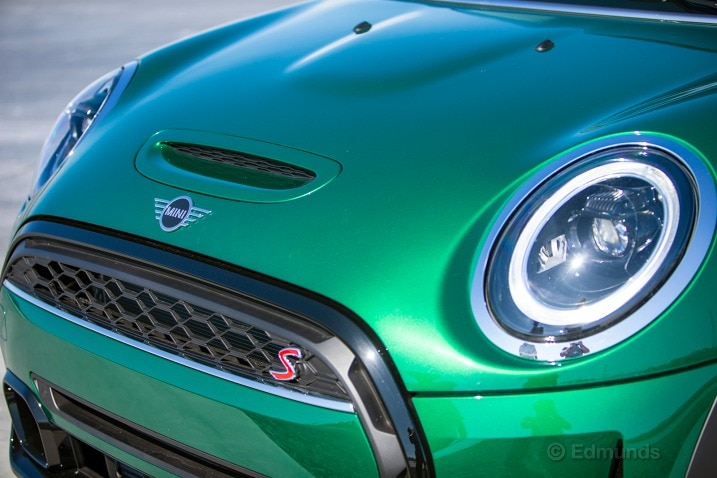

From the start, you'd have to figure that there's no way the Mini E can be any good.
For what seems like a decade, I've been sitting in on meetings where assorted BMW brainiacs would tell me that diesel, diesel, diesel is the key to the clean air future. They said that the electric car is a complicated answer to a local transportation problem, just a circus stunt that pandered to the loonies in the California state legislature.
So there's no way that the Mini E can be any good. It's not like the BMW engineers put much effort into it. This thing is just a bunch of batteries duct-taped to a Mini, about one step removed from entry in the Dodson Middle School Science Fair. BMW is even too cheap or lazy or insincere to conduct a real evaluation with a test fleet, and instead has dropped this mess into the laps of hapless consumers, making them pay for the privilege of being test subjects.
So who would have guessed that the Mini E is the best electric car I've ever driven. And I've driven a lot of them, both serious and stupid.
I drove the 1997 General Motors EV1, which was really good in the way it worked, but cursed by potential cost (Americans want electric cars to be cheap, not expensive), a two-seat package (Americans want a back seat, even if they never use it), and the intellectual laziness of most automotive writers, who are always eager to make General Motors look dumb (because they're hoping it makes them seem smart).
I drove the 1997 Honda EV-Plus, which was really, really good around-town transportation for a small family. I even had a charger installed in my garage, expecting further EVs, only they never arrived because California's draconian zero-emissions law for automobiles evolved into something more useful.
Then there was the Chrysler-sponsored GEM, a kind of golf cart with four plastic lawn chairs strapped in place. It was billed as a "neighborhood electric vehicle," and it was just what you wanted if your neighborhood was Disneyland. Then there was the experimental Nissan Hyper-Mini, a kind of battery-powered Little Tykes Cozy Coupe, only it didn't drive as well. And I was one of the very first to drive the Tesla Roadster, a spectacularly interesting idea that drives really well yet also proves that Silicon Valley computer geeks do not, in fact, know anything useful about producing a practical automobile, even when you let them cheat by giving them a Lotus Elise to start with.
Which brings us back to the Mini E, which is so terrific that it almost makes me forgive those BMW engineers and their harangues about diesel. (Diesel is dead by the way, because it's not a zero-emissions technology, and it turns out that Fiat of all companies is in the lead with clean-air technology that it developed with all those billions which GM provided when it looked like it would buy up the crumbling Italian concern in order to source cheap cars for China and India.)
The Mini E's controller for the electric motor is really superior, delivering smooth, infinitely adjustable power delivery instead of just the usual on/off switch. The strong regenerative braking effect takes some getting used to, but the necessary driving technique came to me after about 50 miles, and left-foot braking helps you get the light-effort deceleration that you sometimes need.
The Mini's package size should be a liability, because it really is a simple science experiment with a back seat packed with batteries. (I went to the grocery store and came back with half the load in the front passenger seat.) But the package also works for the electric car concept. The Mini isn't tall, so the center of gravity is low enough to minimize the sensation of weight transfer as you start, stop and corner. And while the batteries are heavy, the Mini's relatively short-travel, over-sprung suspension seems settled down by all the road-hugging weight.
So far, driving range is the biggest issue, because housing prices in Los Angeles force people to live stupidly far from where they work, and the 80 miles on the meter when I took the wheel wouldn't get it done for a there-and-back trip for some of the people on the staff. Also errands during the work day are more problematic now because all the electric terminals that were put in place around town at banks, grocery stores and post offices when the zero-emissions mandate first appeared on the horizon disappeared long ago. On the freeway, the Mini E uses very little charge when you're cruising along at 70 mph, a bit more in stop-and-go, 20-mph commute traffic (mitigated by the range you gain from the regenerative brakes), and so much charge during 30-mph-to-60-mph expressway traffic that the range meter plummets and you wonder if you'll make it home.
And yet the Mini E's biggest asset as an EV is simply that it is a Mini. Because the Mini is a car that intrinsically seems so smart, stylish and practical, the whole idea of an EV now seems smart, stylish and practical. If the GM EV1 had inspired such open-mindedness among drivers more than a decade ago, we'd still be seeing it on the road today.
Michael Jordan, Executive Editor @ 1,825 miles
bankerdanny says:
05:47 PM, 10/12/09
It could be me, but calling the Mini E the best electric car you've ever driven seems like damning with faint praise and not at all like calling it a good car in general.
hpcarter says:
05:53 PM, 10/12/09
Let me know how it drives in Chicago in January after a foot of snow has just fallen.
cwc1 says:
06:01 PM, 10/12/09
Diesel dead? I don't think so.
cwc1 says:
06:02 PM, 10/12/09
Also, electrics *aren't* zero emissions technology.
stephen987 says:
06:33 PM, 10/12/09
It's absurdly expensive, and I'd have to drive 100 miles to get even a regular Mini serviced. I don't have a garage, so nowhere to plug it in. It won't go far enough to get me to anywhere more interesting than here.
Sorry, but till an EV can match the 300 mile range and 10 minute recharge time of an ordinary car, at a comparable price, I ain't buying.
firstwagon says:
07:17 PM, 10/12/09
"Also, electrics *aren't* zero emissions technology"
In all fairness that depends where you live. Here in British Columbia our power comes from hydro which is zero emissions.
So electric cars are indeed zero emissions here.
In most places in the US where cheap and easy power was more important then the environment, electric cars are emission transferable rather then emissions free.
ddoouugg says:
07:28 PM, 10/12/09
How do you know about Dodson Middle School? I used to have basketball practices there and I live relatively close.
empowah says:
08:13 PM, 10/12/09
When I was younger, our neighbor who worked for Nissan had an Altra EV wagon. He owned it for five years, long after Nissan stopped making them, used daily by his family for carpools, running errands, daily commutes, etc. I still recall thinking how utterly conventional it seemed; essentially it's a "crossover", like the ones we see today, with tons of space inside and a 100+ mile range.
The only sign it's something special was the cord dangling on the driveway at night. It was completely reliable and used proven technology. The main problem was its price ($51K). Hopefully, li-ion batteries (which the Altra used) have come down in price after 10 years...
mercedesfan says:
09:02 PM, 10/12/09
@firstwagon,
Hydro is far from zero-emissions in terms of its collective effect on the environment. The construction and implementation of hydroelectric dams permanently and irreplaceably destroys entire ecosystems. It is for that reason, at least here in the States, that never again will a hydroelectric dam every be constructed. There is no form of power that is more damaging to the local environment. For the record I'm not some crazy environmentalist (a good friend of mine works in power so I often talk to him about these things) and I'm not attacking anything you said, just making a point.
hybris says:
10:16 PM, 10/12/09
Really Diesel dead? In SoCal or even just California as a whole yes your statement could be very true but outside of the country/state diesel while not the main source of power for commuters is still alive and well.
dougtheeng says:
05:54 AM, 10/13/09
Interesting article. As a result of costs, the MINI-E isn't yet a realistic alternative for those of us who live in the real world; however, I really do believe its a step forward - a large step at that. Its a practically packaged vehicle that, price aside, would be great for many, many people out there (myself included). Put this at the same cost (or better yet, less) then a regular MC and you've got a vehicle for the future.
jasper53 says:
10:41 AM, 10/13/09
One of the biggest social issues yet to be addressed by the move to electrical vehicles is the tax situation. The current gas tax tax builds a significant amount of transportation infrastructure (and a number of other government projects that it was never intended for) in this country. Even today, the combination of better fuel economy in fossil fuel cars and fewer miles being driven is causing havoc for the government tax income structure. I have got to believe that the state and federal government will find a way to tax the electric cars in order to recover the revenue.
Perhaps each car on the grid will have a unique ID and it will send a message on the Internet every time you charge the vehicle so that you will be billed. Perhaps we will move to a mileage based tax system where you (or the vehicle itself) will have to report its milage on a monthly basis so that you can be taxed for your "fair share" of road use. Believe me, the federal and state governments will figure out a way to get their money from you for the "privilege" of owning a car.
Electric vehicles will not look nearly as attractive by the time the government finishes taxing you one way or the other. This tax, combined with the increased cost of having to buy the more expensive battery-based technology in the upfront vehicle cost will put a damper on automotive sales and our economy. Even leasing the battery over time as a financing alternative will drive the true cost per mile through the roof.
This is just one more way that the environmentalists will try to move all of you towards a mass transportation solution. This may be a viable approach if you live and work in a big city -- but unlike Europe, this is not how our employment and retail infrastructure has developed. To change any of these aspects of the US society is just too expensive. The environmentalists goal is to tax and tax as a way to change human behavior without regard to the impact on the economy of the average American.
It would be great if Edmunds could write an article on the true long term financial implications of electric vehicles.
cneff says:
11:25 AM, 10/13/09
I think you nailed it. Regardless of the range, cost or lack of current infrastructure the fact that this EV is a MINI Cooper is the point. It does not look like a concept car or an obvious econ-purposed-box. It is a recognized icon that is an EV - pretty slick
Technology will improve and all the issues with EVs will be addressed over time, just like they were with diesel. Oh and I also drive one of the new clean diesels SUVs - works great.
I've got MINI E #402 in NJ and love it for being an EV and still a MINI Cooper
http://www.mymini-e.blogspot.com/